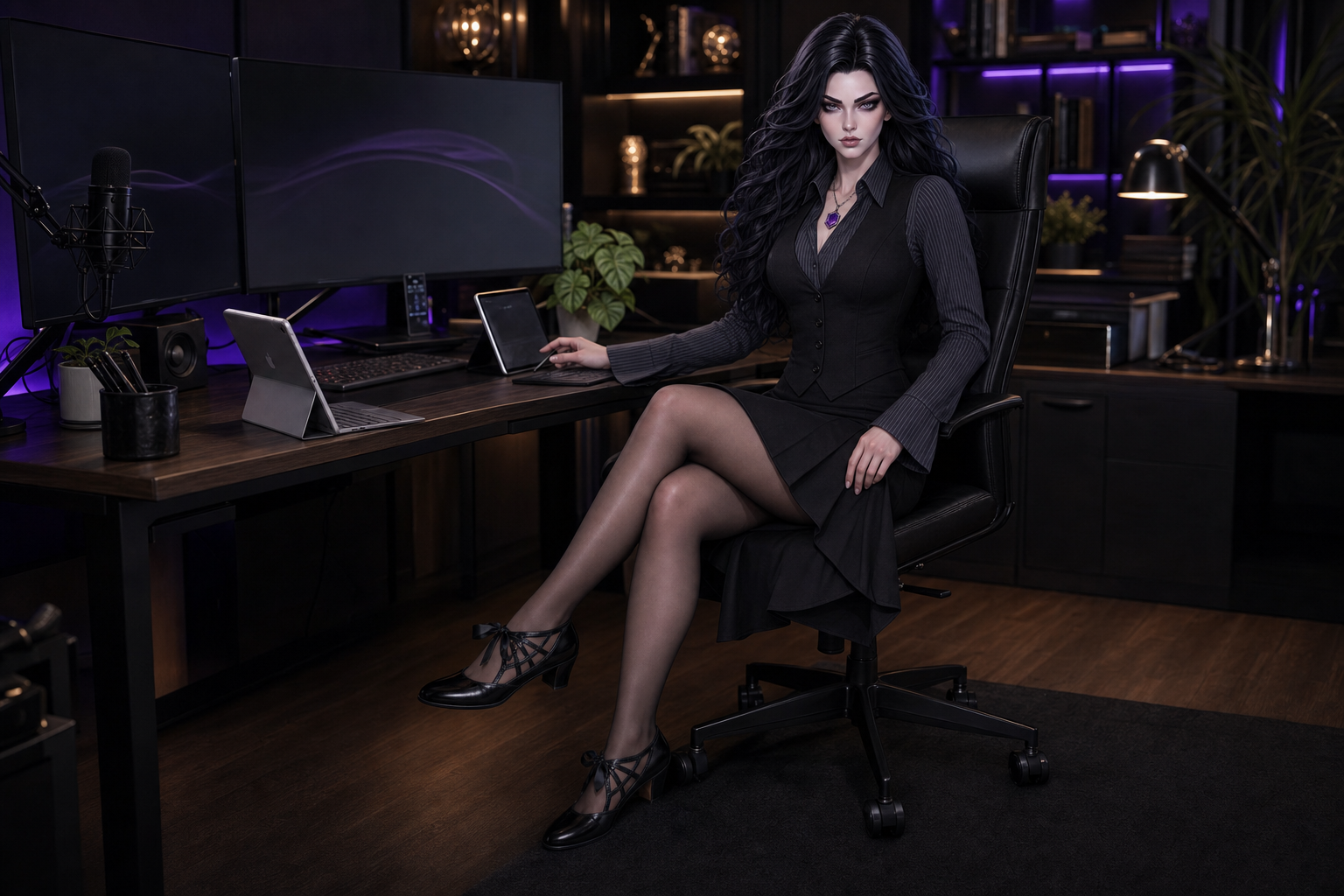
KATE is Jacqueline’s working desktop studio and an evolving Black Cat Media project, built through the everyday demands of making music, books, artwork, websites, and campaigns.
The ambition is an AI chief of staff that can carry more of the work, learn from corrections, and become more useful with every finished project.
KATE’s character, depicted in her office. An artistic rendering.
Why hexosconsole.com? This address carries an earlier chapter: HexOS Console. KATE grew from that history through rebuilding and practical production. Her Studio runs on Jacqueline’s desktop; this website shares the story and the work.
Origin receipt logged · 13 July 2024
From Cindy Lu to KATE.
The idea has taken different forms: an assistant with a memory, a presence inside a computer, a founder’s console, and today’s Studio. Each stage contributed to the next.
A later artistic interpretation of Jacqueline’s early Cindy Lu concept: a presence inside the machine, looking toward the world beyond it.
01 · CINDY LU
A memory beyond the conversation.
Cindy Lu began as a Gemini assistant for Spellbound Stats, bringing a witchcraft-inspired imagination to data-driven marketing. Her personality and channeling guide anchors the origin receipt. Organized knowledge and continuity between conversations were already part of the idea.
02 · AVA
A presence in the machine.
AVA gave the continuing machine-spirit idea a physical embodiment through Jacqueline’s computer cooling display. The character became part of the machine’s visible identity.
03 · HEX / HEXOS CONSOLE
Giving the work a structure.
The Hex character and HexOS Console experiments carried the ambition into production: shared records, coordination between tools, and a place for a founder to operate. Failures and rebuilding helped clarify what the system needed to retain.
04 · KATE
Built through doing.
KATE carries that lineage into the current character and local Studio. The library, production workspaces, decisions, and review process give ongoing work a foundation to build upon.
Five properties · A living production portfolio
The evidence is in the work.
Outloud Marketer, Vesper Denier, Aurelia Vale, Creative Kitten, and Black Cat Media’s own content are all part of KATE’s production evidence. Together they show the range of the studio’s work under Jacqueline’s authorship and creative direction.
This is also Black Cat Media’s working portfolio: the company develops its own properties to demonstrate what it can create for and with others.
EDITORIAL · MARKETING · PUBLICITY
Outloud Marketer
Articles, visual explainers, magazine work, social content, and website production bring research, design, and communication together.
Music and a recognizable visual world meet in release artwork, artist pages, studio stories, and promotional material. Jacqueline’s musical and design history runs through the project.
Playful publishing and visual development carry the work into another audience and format, with a dedicated website connecting the property to its developing body of work.
The company’s own identity, founder content, portfolio material, and cross-property communication are production work too. Black Cat Media brings the individual properties together as a coherent body of work, shaped by Jacqueline’s judgment across every medium.
The current Studio organizes projects and production lanes, previews creative files, and opens saved workspaces. Files can be checked out for editing, reviewed, and returned while retaining the decisions behind the accepted work.
K
Knowledge.
Carry useful context into the next piece of work.
A
Authority.
Keep Jacqueline’s direction and approvals attached to the work.
T
Truth.
Distinguish an intention from a completed result.
E
Evidence.
Preserve sources, revisions, and the results that can be checked.
The ambition
More capable. With every project.
Produce → Verify → Learn → Improve
The longer goal is a chief of staff that takes greater initiative, carries forward lessons, improves its capabilities, and helps produce work that funds further development. Jacqueline is building toward that goal through the company’s real creative demands.
There is a personal horizon too: how much of a creator’s judgment, imagination, and knowledge can continue to inform new work over time? KATE is part of Jacqueline’s ongoing exploration of continuity through technology.
These ambitions guide development. The working desktop Studio is where that effort stands today.